
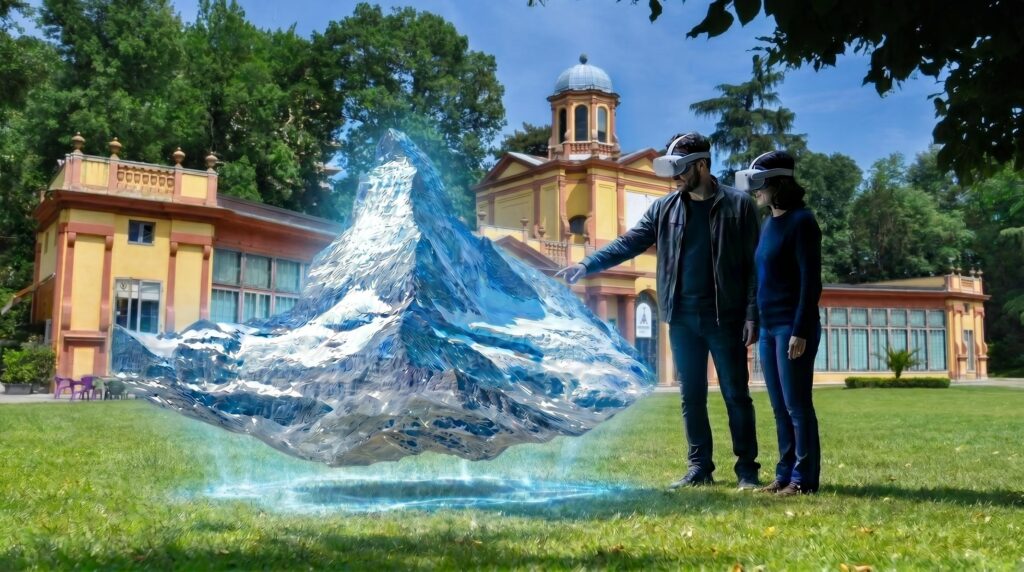
On the occasion of the National Assembly of the Italian Alpine Club (CAI), an experiential and exhibition context called “CAI Village” was developed at the Ducal Gardens in Modena.
The initiative combined geographic 3D modeling with extended reality on head-mounted displays.
Visitors were able to explore the Matterhorn and relive the authentic traverse undertaken by instructors from the Modena CAI section, who ascended from the Italian side and descended from the Swiss side.
The digitized 3D model offered an accurate perception of the stairs and slopes, impossible to achieve with traditional media.
The climbers’ route was not a simple line, but a narrative axis; users activated multimedia memories directly at the geographic points where they were recorded.
This technology represents a fundamental evolution for local museums, often limited by limited physical spaces and static exhibits.
Dedicated museums can archive and render historical or contemporary great climbs infinite, and these feats become permanent interactive itineraries that visitors can virtually walk.
High-altitude mountains are by their very nature elitist, accessible only to physically fit and expert mountaineers: in these cases, extended reality breaks down these barriers and allows children, the elderly, and those with mobility disabilities to “experience” the summit.