
Sector: Museum / Cultural Heritage / Urban Studies / Architecture
Philological reconstruction of the defensive elements and original aesthetic appearance of the Rocca di Vignola (MO).
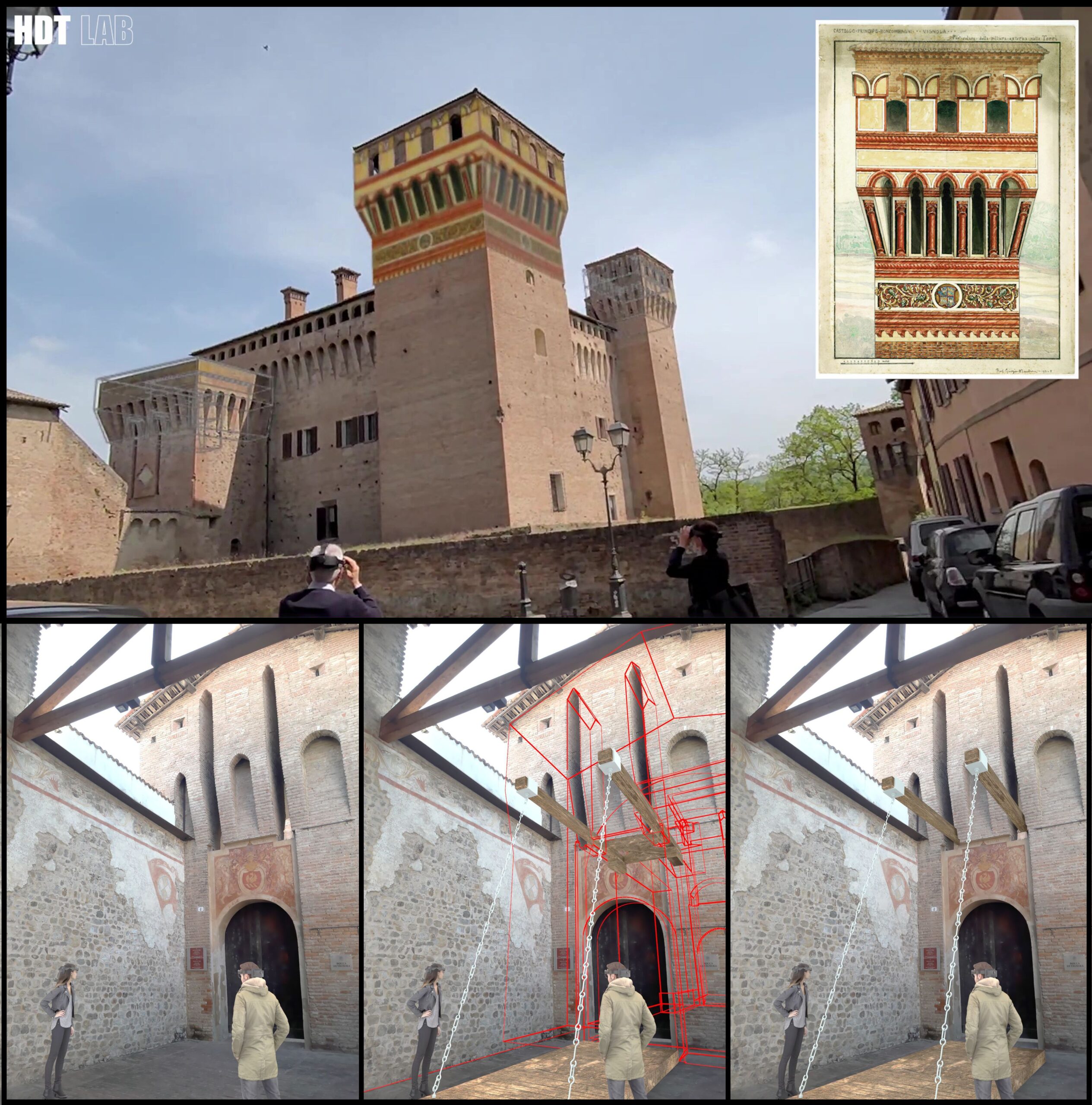
The Rocca di Vignola is one of the most beautiful and interesting medieval fortifications in Italy, thanks to the Fondazione di Vignola, the castle’s owner, which stands out for its excellent maintenance and management of the asset. Being a complex sedimentation of history and architecture, the idea of showing and animating defensive elements now long gone — allowing users to understand their mechanical operation — and restoring the original fifteenth-century aesthetic, when the towers were not “bare stone” but richly decorated, without touching or altering the real structure, struck us as an important “intersection” between the evolution of siege warfare techniques and noble identity.
In this project, the physical building was used as the load-bearing structure for the digital model, with three-dimensional modelling carried out to overlay the 3D model onto the existing structure with precision. This allowed the real fortress to be used as an “anchor” for the virtual elements.
Drawbridges and defensive systems were reconstructed following the assessments of experts in castellology and fortified architecture from the Italian Institute of Castles, ensuring that the movement animations were mechanically plausible.
Drawing on the beautiful “Tracce in Luce” project with its scientific analysis of the minimal pictorial traces still in existence — where colour and heraldry have returned to communicate the castle’s rank — we used vectorisation and texturing techniques to virtually reconstruct the patterns that once adorned the towers, restoring them to their original polychrome splendour.
The experience for the user wearing the XR visor will be like a “walk” in the 15th century around the fortress. As they approach the entrances, virtual drawbridges will activate, revealing the complex system of counterweights, pins and chains at real scale. Looking up at the towers, the visor will in real time add fifteenth-century colours to the current walls, allowing the decorative scheme to be restored without the need for invasive restorations or scaffolding.
Thanks to the 1:1 scale, the perception of volume and defensive power is total, transforming a static visit into an interactive history lesson. The result: an immediate understanding of military architecture concepts that would be complex to explain using only two-dimensional panels.
App used: HDT Heritage.