
Sector: Museum / Archaeology / Social (Inclusivity)
Virtual reconstruction and manipulation of archaeological objects for Inclusive Accessibility.
This case study is extraordinary because it shifts attention to two topics of great social value: universal accessibility and virtual tactile interaction. The idea of “extracting” an object from an unbreakable display case to allow anyone to study it up close is the dream of every museum curator.
Archaeological museums often house small artefacts enclosed in display cases that limit volumetric and tactile understanding. The success of this project is the result of close synergy with the Museo Simonini of Castelfranco Emilia and its director, Dr Diana Neri, whose far-sighted vision made it possible to experiment with these technologies towards genuine scientific and educational utility, for inclusive enjoyment of archaeological heritage.
In the case of Museo Simonini, the challenge was to allow visitors to examine the details of bronze ingots (Aes Signatum) dating from the 6th–5th century BC (Iron Age), discovered at the end of the nineteenth century inside a large ceramic vessel. These artefacts are fundamental for reconstructing the trade routes and economy of the populations that inhabited the Castelfranco Emilia area thousands of years ago.
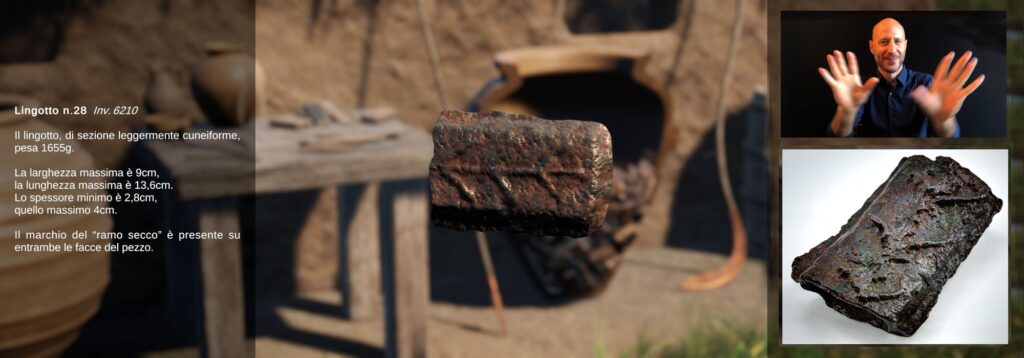
The artefacts were digitally modelled with extreme realism, creating high-fidelity “digital twins” that reproduce every engraving and porosity of the original material. Using state-of-the-art headsets, and approaching the display case, the visitor can virtually “extract” the ingot from behind the glass with a simple hand gesture, rotating and enlarging it in the physical space in front of them.
The experience was enriched with Italian Sign Language (ISL) videos: instead of having to read external panels, the user views an ISL video integrated into the XR environment, which explains the history and use of the ingots in a natural and immersive way. The project transforms Museo Simonini into a benchmark of excellence for museum accessibility.
App used: HDT Museum.